When people hear "VPN," most probably picture something like "a way to connect securely to the corporate network" or "security technology that keeps out unauthorized access."
That isn't wrong, of course.
But at its core, a VPN is also a technology for virtually connecting networks that sit in different places.
In other words, a VPN has two main kinds of value:
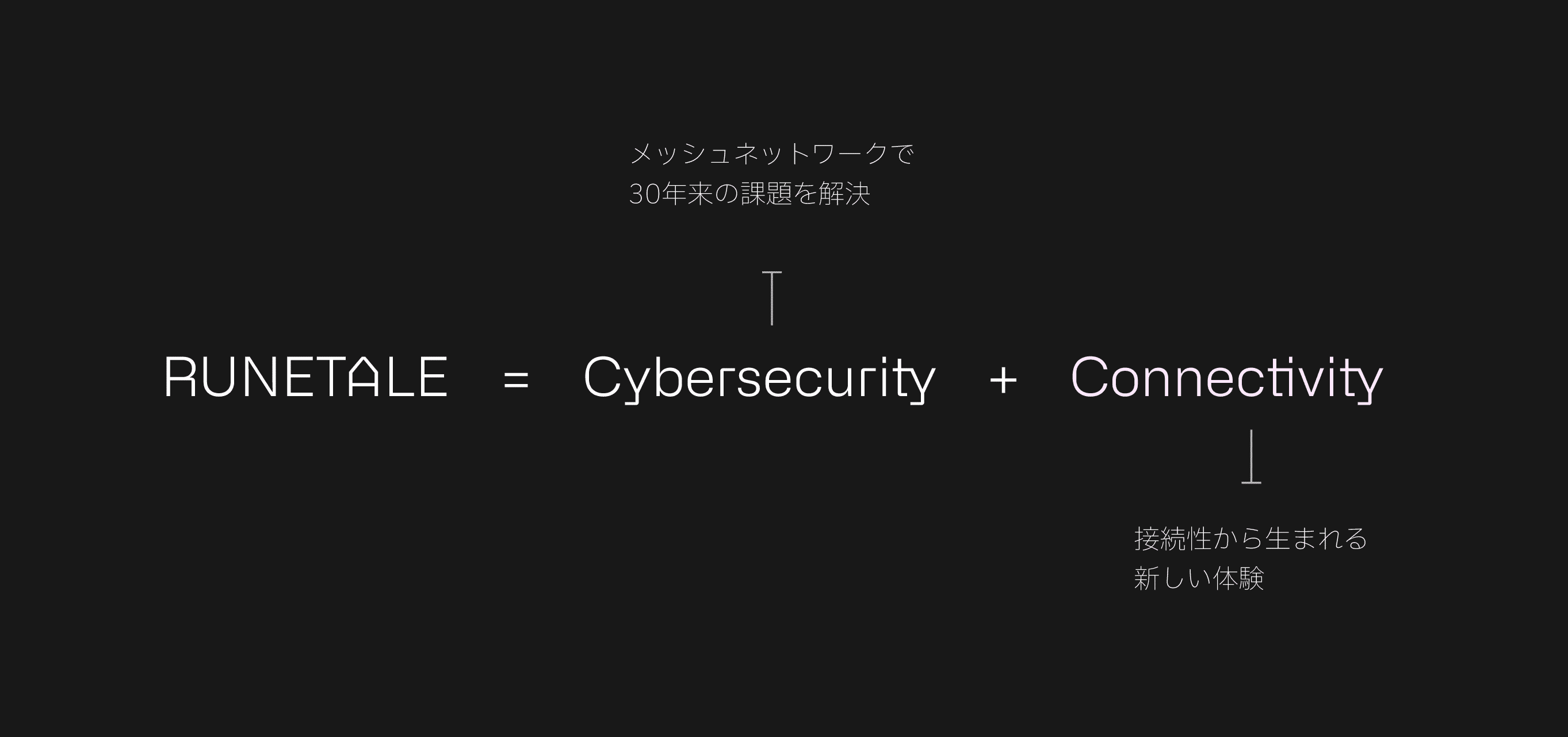
Cybersecurity and Connectivity.
We believe Connectivity is about to matter a lot more.
1. The VPNs that have held up the internet

A VPN (Virtual Private Network) builds a virtual private network on top of a shared network such as the internet.
It has many uses: Site-to-Site VPNs that connect a company's offices and data centers, remote access VPNs that let people reach internal systems from home, and more.
VPNs also play an important role behind the services we use every day.
They connect all kinds of environments: corporate cloud platforms, employees' PCs, IoT devices on factory floors, internal databases.
A VPN isn't just a way to encrypt traffic.
It's a technology that connects systems in physically distant places as if they were on the same network.
And the further digitalization goes, the more it's needed.
But the environment around networks has changed dramatically since VPNs first spread through companies.
2. Rising cyberattacks and the problems with traditional VPNs

In recent years, cyberattacks on companies and public institutions have come one after another.
The methods keep diversifying: ransomware, unauthorized access, credential theft, intrusions that exploit software vulnerabilities.
VPN appliances that connect into corporate networks are one of attackers' most important targets.
That's because a VPN is the entrance to an organization's internal resources.
Once attackers get in through a vulnerability in a VPN appliance or with stolen credentials, they can use it as a foothold to go after servers and databases further inside.
Using a VPN isn't dangerous in itself, of course.
The problem is that internet-facing access infrastructure has to be maintained properly, forever, and that some setups don't adequately limit what an intruder can reach once inside.
Cyberattacks are changing with AI

On top of that, the spread of AI is starting to change how attacks work.
Some tasks that used to take specialist knowledge and time may become more efficient with AI.
For example: gathering public information, researching vulnerabilities, writing phishing messages, analyzing malicious traffic.
There's concern that attackers using AI will lower the cost of preparing and carrying out attacks.
Companies, in turn, need to rethink how they protect their networks.
The internet has changed. Has the way we connect?
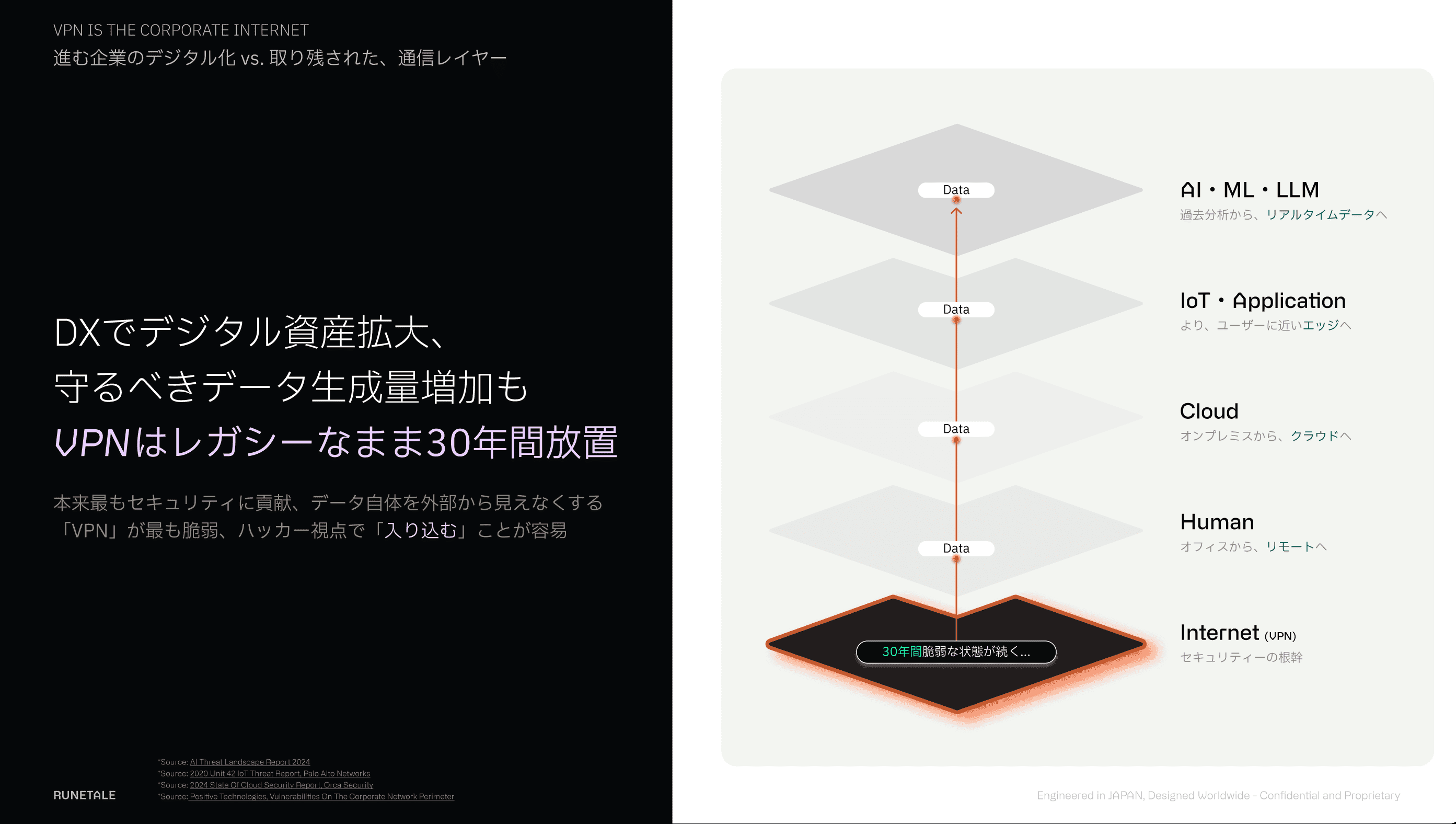
Companies' critical systems used to live inside offices and data centers.
Putting a VPN Gateway in place for outside access to the internal network was a rational choice.
Today, though, the digital assets a company manages are spread across clouds like AWS, SaaS, employees' PCs, IoT devices, and more.
And from here on, AI agents will join those networks too.
Not just people: software itself will communicate autonomously, fetch data, and carry out work.
In this environment, is a design that funnels every access through a single entrance always the best one?
We believe this is where the structural problem with traditional VPNs lies.
3. The fundamental difference between traditional VPNs and Mesh VPNs
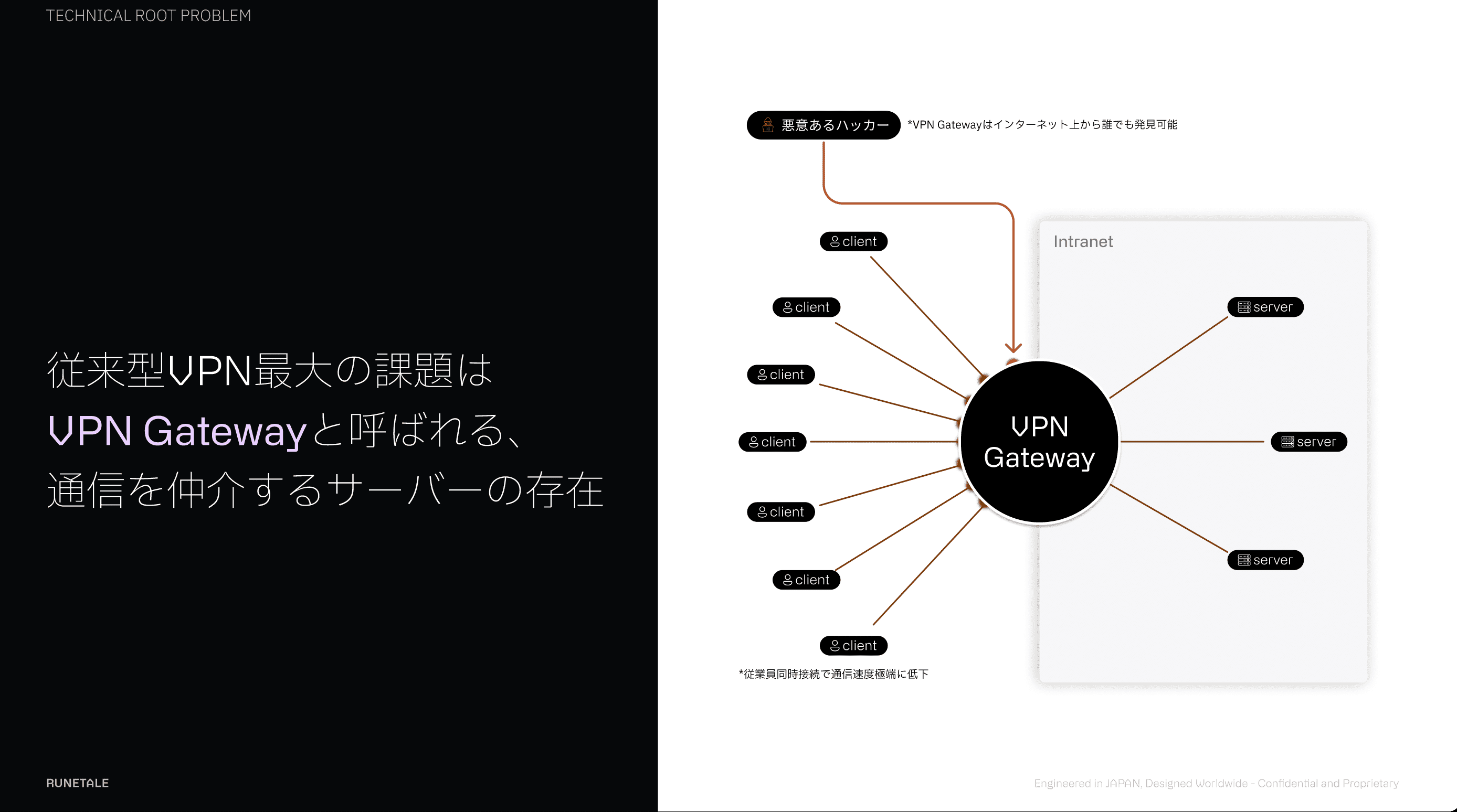
A traditional centralized remote access VPN connects you to the target network through a device or server called a VPN Gateway.
For example, accessing a company server from a PC at home takes this path:
PC → VPN Gateway → internal server
This is a Hub-and-Spoke design that concentrates traffic around the gateway.
It lets you manage a single entrance, but it comes with several problems.
First, when traffic concentrates, the gateway's processing power and bandwidth can become a bottleneck.
Second, a gateway failure can affect every connection.
Third, the gateway becomes a target for outside attacks, which makes authentication and vulnerability management critical.
To address these problems, we use a Mesh VPN.
A Mesh VPN connects devices directly
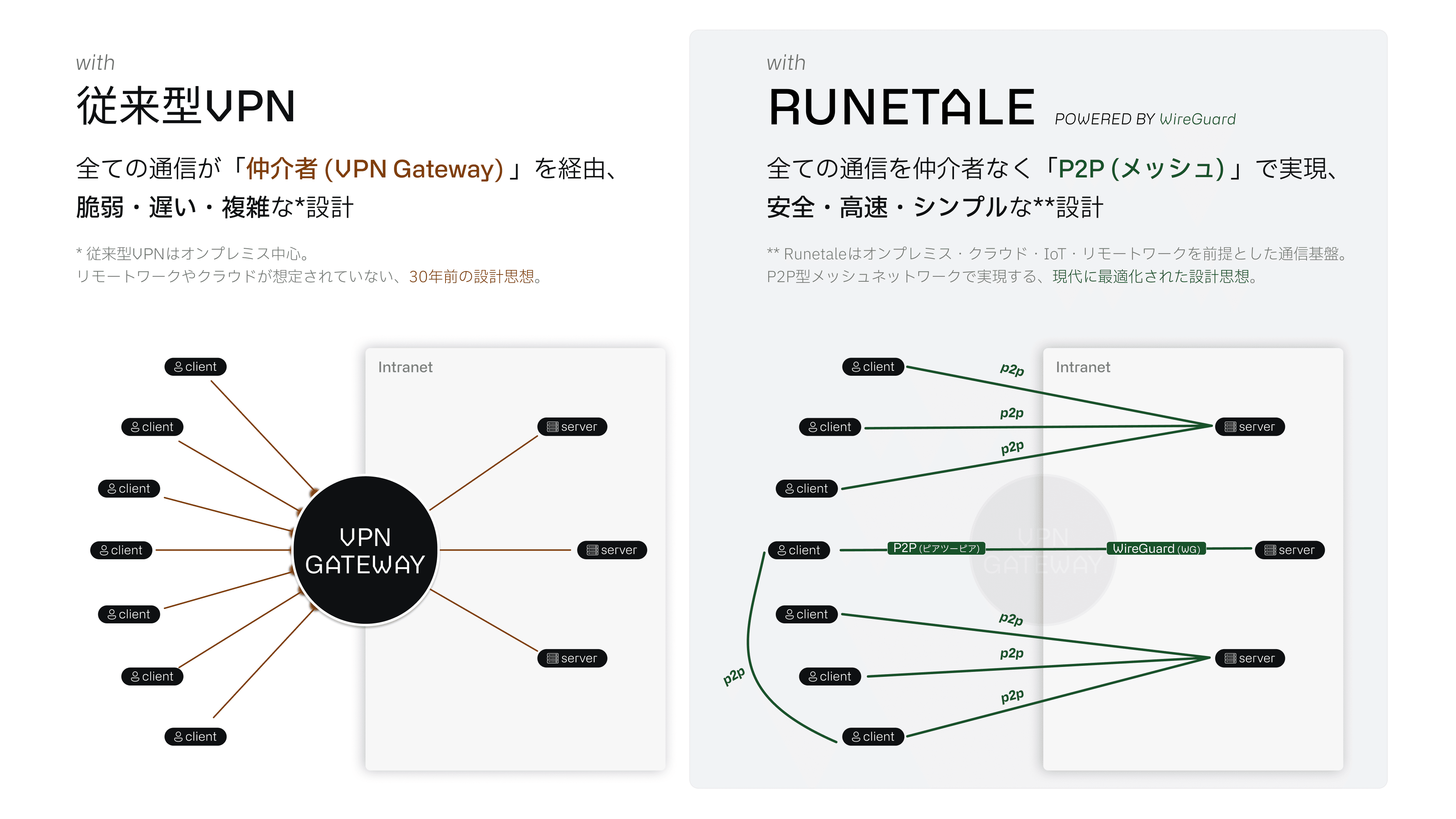
In a Mesh VPN, devices on the network talk to each other directly whenever possible.
For example, when a developer's PC connects to a server on AWS, the two devices recognize each other and establish an encrypted P2P connection.
That removes the need to funnel all traffic through a central VPN Gateway.
Of course, some environments block direct connections because of NAT or firewalls.
In those cases, a relay server forwards the traffic.
What matters is that instead of always going through a gateway, the network can set up the right path for each environment.
Making complex network setups simple
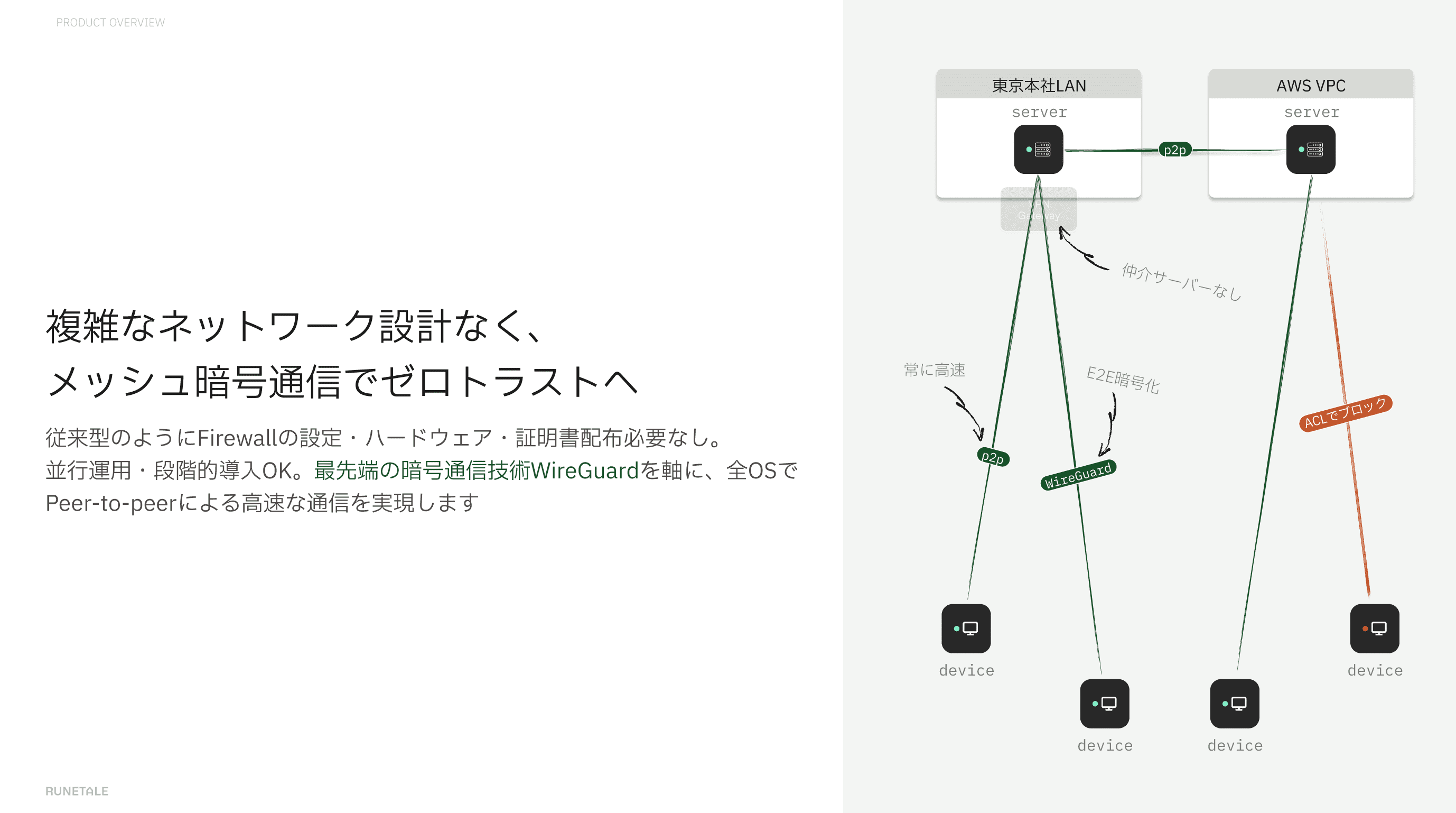
Connecting multiple clouds, data centers, and local environments used to require configuring routing, firewalls, VPN Gateways, and more.
Runetale abstracts that network complexity away in software.
Between devices on Runetale, traffic is encrypted with WireGuard, and access control is applied based on user and device identity.
Rather than relying only on IP addresses or where something sits on the network, it manages which users and devices can access which resources.
This approach fits well with the idea of zero trust.
Zero trust is a security model that verifies permissions based on who is accessing what, instead of assuming "it's safe because it's on the internal network" or "it's trusted because it's on the VPN."
Combining a Mesh VPN with access control gives you a secure connectivity foundation for distributed resources.
4. VPNs aren't only about Cybersecurity
So far, I've covered the problems with traditional VPNs and how a Mesh VPN works.
But improving security isn't the only reason we're working on Mesh VPNs.
If anything, we see huge potential in connectivity itself.
The essential role of a VPN is to connect computers and networks in different places.
For example: using an application running in a local environment from another PC, reaching your home development environment while you're out, or talking securely to a database in the cloud.
We think all of this should be much easier.
On today's internet, connecting distant computers means understanding all kinds of machinery: IP addresses, ports, firewalls, NAT, authentication.
Yet devices on the same LAN can usually talk to each other far more easily.
What if you could work from anywhere on the internet as if you were on the same LAN?
That's the Connectivity Runetale is aiming for.
Rethinking the VPN not just as a product that protects corporate networks, but as infrastructure that freely connects distributed computers.
Security matters, of course.
But beyond chasing safety alone, we should ask what becomes possible once things are connected.
We believe networks need to be designed with that potential in mind.
5. The Connectivity the AI era demands
And the era where Connectivity matters even more is the era of AI agents.
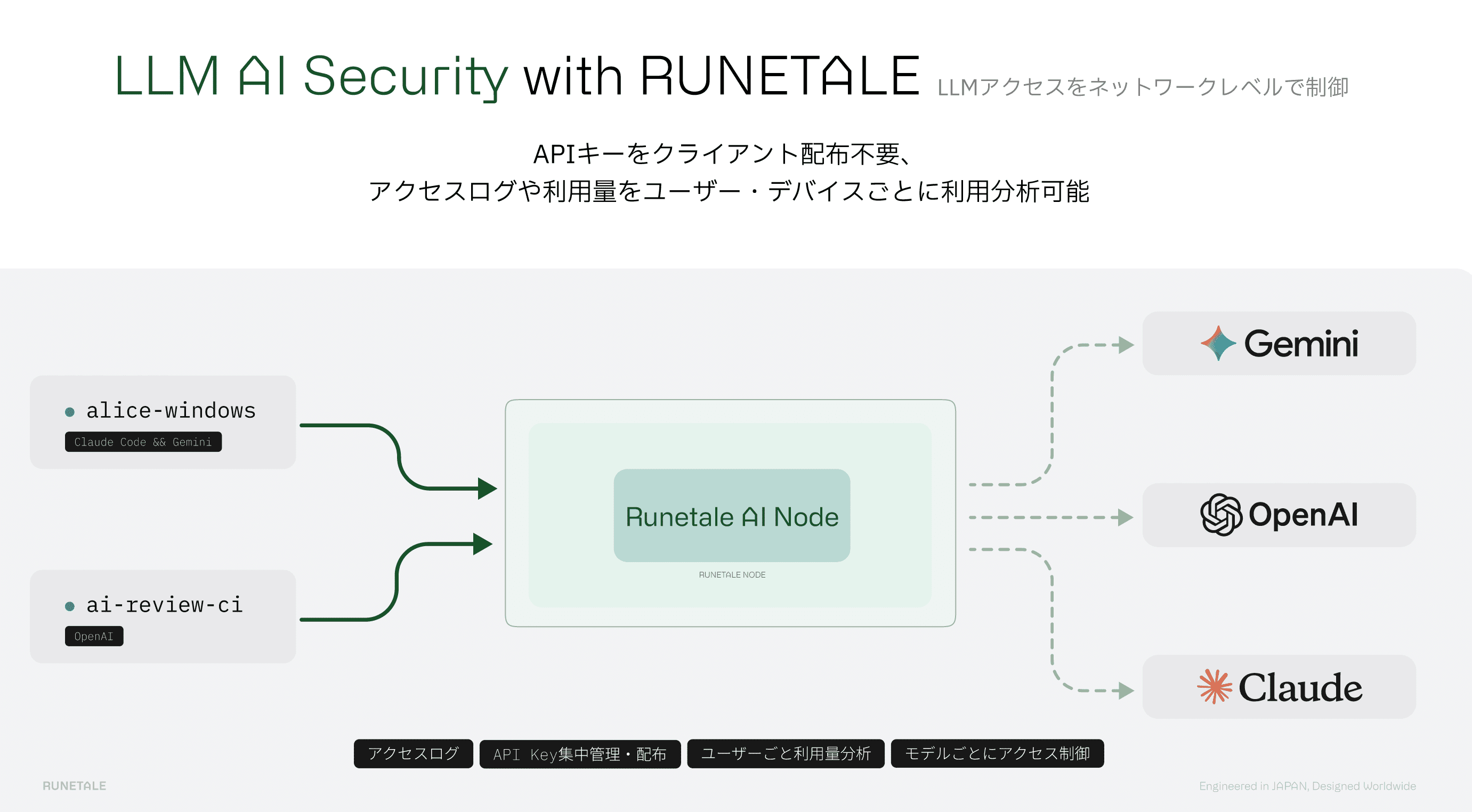
Until now, networks have been designed around PCs and servers operated by people.
But once AI starts generating code, calling APIs, and operating databases on its own, the very things connecting to the network begin to change.
Not just people: AI agents and software will be spread across many environments, getting work done while communicating with each other.
At that point, encrypting traffic alone won't be enough.
Who can access what, and from which device? And how easily can they connect?
Both security and connectivity will matter more than ever.
We think of the network that lets these AI agents communicate autonomously as an "Agentic Network."
We believe the Mesh VPN Runetale is building can be a foundation for it.
I'll go into Agentic Networks in more detail in another post.